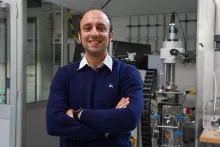
Federico Bella is Full Professor of Chemistry at Politecnico di Torino, where he carries out research and teaching activities in the fields of electrochemistry, energy materials, and sustainable electrochemical systems.
His scientific activity focuses primarily on the development of next-generation batteries, polymer and hybrid electrolytes, electrochemical energy-storage systems, supercapacitors, and electrocatalytic processes for the sustainable production of chemicals and fuels. In particular, his research addresses lithium-, sodium-, and potassium-ion batteries, lithium–sulfur batteries, solid-state systems, and electrochemical processes for the conversion of nitrogen and nitrates into ammonia. A distinctive feature of his work is the integration of materials design, advanced characterization, mechanistic investigation, and device development with potential technological applications.
Throughout his career, he has coordinated and participated in numerous national and international research projects, securing several million euros in competitive funding. He served as Principal Investigator of the ERC Starting Grant “SuN2rise”, devoted to solar-driven electrochemical nitrogen fixation, and has subsequently developed projects aimed at technology transfer and the industrial valorization of research outcomes, with particular attention to sustainable ammonia recovery and circular electrochemical systems.
He is the author of numerous publications in international scientific journals and has achieved significant scientific impact, with more than 12,000 citations and an h-index above 80. His research activity has been recognized through several national and international awards, including the ENI Award and other distinctions in the fields of electrochemistry and energy materials.
Alongside his research activities, Federico Bella plays an active role in the scientific community. He has served as Vice-President of the Italian Chemical Society and holds editorial positions in international journals and book series covering sustainable energy and advanced materials. He also regularly contributes to the international evaluation of research projects, doctoral theses, and scientific manuscripts.
His scientific activity combines fundamental research, technological development, and collaboration with industry, with the aim of contributing to the energy transition through more efficient, sustainable, and circular electrochemical materials, processes, and devices.