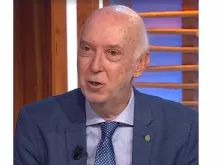
Gianfranco Pacchioni is Full Professor of Materials Chemistry at the University of Milano-Bicocca, where he has also served as Vice-Rector for Research and Director of the Department of Materials Science. His work focuses on quantum theory of matter, with particular attention to inorganic materials and their surfaces, metal clusters (aggregates of a few atoms) and nanoparticles, catalysis, and photocatalysis. He is the author of over 600 scientific publications.
He earned his degree in Chemistry in Milan (1978), obtained his Ph.D. from the Freie Universität in Berlin (1984), and has conducted research at the IBM Research Center in Almaden, California, the Technical University of Munich, the University of Barcelona, the University of Paris VI, and the Fritz-Haber Institute in Berlin. For his research, he has received the Nasini Medal (1994), the Pisani Medal (2017), and the Cannizzaro Medal (2024) from the Italian Chemical Society, the National Federchimica Award (1996), the Humboldt Research Award (2005), and the Pascal Medal from the European Academy of Sciences (2016). He is a member of the National Academy of the Lincei, the Academia Europaea, the European Academy of Sciences, the Istituto Lombardo Academy of Sciences and Letters, the Veneto Institute of Sciences, Letters and Arts, and the Academy of Engineering and Technology.
He has published several popular science books: Ideas for Becoming a Materials Scientist: From the Invention of Paper to Nanotechnologies (Zanichelli, 2006); How Small is the World: Surprises and Hopes from Nanotechnologies (Zanichelli, 2008); Science, Quo Vadis? Between Intellectual Passion and the Market (Il Mulino, 2017) (English translation Oxford University Press, 2018; Spanish translation Alianza Editorial, 2021); The Last Sapiens. Journey to the End of Our Species (Il Mulino, 2019); Long Live CO₂: Can We Turn Lead into Gold? (Il Mulino, 2021); The Nanoworld: From Viruses to Transistors (Dedalo, 2021); Fantastic Materials and How to Create Them (Zanichelli, 2023); Clear Science, Dark Science (Il Mulino, 2025).