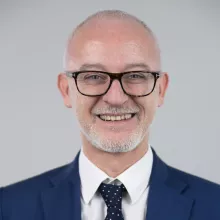
Luigi Crema is Director of the Sustainable Energy Center at Fondazione Bruno Kessler (FBK), President of Hydrogen Europe Research, and Vice-President and Chair of the Scientific Committee of H2IT – Italian Hydrogen Association. He is also a member of the Academic Board of the PhD Programme in Industrial Innovation at the University of Trento and a founding member of ITATEC – Italian Academy of Engineering and Technology.
His professional career, spanning both research and industry, has been devoted for more than twenty years to sustainable energy technologies and systems. Following early experience in sensor technologies and industrial processes, he joined FBK in 2007, progressively taking on scientific and managerial responsibilities and becoming Director of the Sustainable Energy Center in 2021. His research has focused particularly on hydrogen, integrated energy systems, energy storage, advanced materials and solar technologies, combining technology development, modelling and techno-economic analysis. His scientific output includes 60 Scopus-indexed publications, 1,630 citations and an h-index of 21.
He has coordinated several European projects in the energy and hydrogen fields and contributed to the development of research and innovation strategies at both national and European levels. A particularly significant achievement was his contribution to the development of the Italian national hydrogen mobility scenario, whose results were subsequently incorporated into Italian legislation.
Since 2023, he has served as President of Hydrogen Europe Research, being re-elected in 2024 and 2026, and is a member of the Governing Board of the Clean Hydrogen Joint Undertaking, contributing to the definition of European hydrogen research and innovation priorities. In parallel, he promotes the transfer of research results to industry and the development of major experimental infrastructures, including the new Hydrogen and Batteries Hub in Rovereto, fostering integration between research, industry and the regional innovation ecosystem.
His work is characterised by an interdisciplinary approach connecting scientific research, technology development, industry and energy policy, with particular attention to building innovation ecosystems and supporting the development of the next generation of researchers.