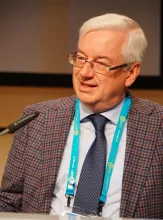
Luciano Iess is Full Professor of Aerospace Systems at Sapienza University of Rome. He is Principal Investigator of the geodesy and radio science experiments of the European Space Agency (ESA) missions BepiColombo (to Mercury) and JUICE (to Jupiter’s moons). He led the Gravity Discipline Group of the Cassini mission to Saturn (conducted by NASA, in collaboration with ESA and the Italian Space Agency) and is a member of the science team of NASA’s Juno mission to Jupiter and VERITAS mission to Venus.
He has extensive experience in space navigation systems and in solar system exploration missions, as well as strong ties with the national space industry. For ESA, he developed the correlator of the DDOR (Delta-Differential One Way Ranging) system for high-precision measurement of the angular position of planetary probes - an essential tool for the Agency’s access to deep space. He has also led or contributed to numerous ESA studies for the improvement of deep space navigation systems, particularly based on Ka-band radio links.
Among his more than one hundred scientific publications, he has been first author of six articles in Science and Nature, and co-author of five more in the same journals. His major scientific results include the most accurate experimental verification of Einstein’s General Theory of Relativity and the discovery of subsurface oceans on Saturn’s moons Titan and Enceladus.
More recently, he led the team that obtained gravity measurements of Jupiter and Saturn, used to study the internal structure and atmospheric circulation of the two gas giants and to determine the age of Saturn’s rings. He also led the team that proposed to ESA the architecture for the orbital determination and clock synchronization system of the Moonlight constellation for lunar radionavigation, which was later adopted by the Agency.
Since 1997, he has served almost continuously on ESA’s advisory bodies (Solar System Working Group, Space Science Advisory Committee, Human Exploration and Science Advisory Committee). In 2019, he was appointed member of the Voyage 2050 Senior Committee, tasked with drafting the scientific program guidelines of the Agency for the period 2030–2050.
Luciano Iess has taught thousands of students in Aerospace Engineering courses and Master’s programs at Sapienza and Tor Vergata Universities. He has supervised 17 PhD theses and more than 60 Master’s theses. He has participated in many public science events and is deeply committed to the dissemination of scientific and technological knowledge in civil society.
Main Recognitions
• NASA Exceptional Public Service Medal (2014)
• Jean-Dominique Cassini Medal of the European Geosciences Union (EGU) (2017)
• NASA Exceptional Scientific Achievement Medal (2024)