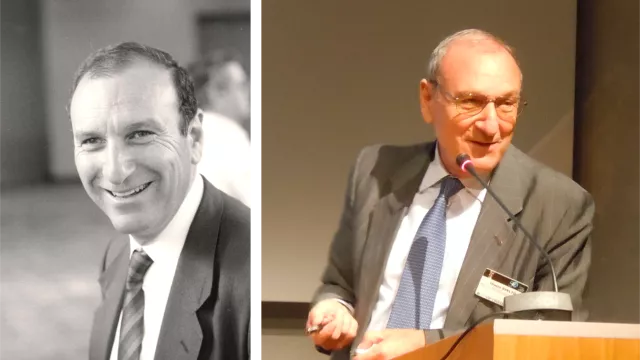
Professor Orazio Svelto, a founding member of ITATEC, passed away on January 9, 2026, just a few days before his ninetieth birthday. His passing marks the end of an era for the global physics community. A central figure in the history of coherent light, Svelto accompanied the evolution of the laser from its uncertain beginnings, helping to transform a "solution looking for a problem" into a cornerstone of modern science and technology.
After graduating in Nuclear Engineering from the Politecnico di Milano and completing fundamental research at Stanford University (1961–1963), he returned to Italy with the vision necessary to establish a new scientific school. One of Svelto’s most defining traits was his extraordinary ability to build institutions and nurture talent. At the Politecnico di Milano, he founded one of the first laser research groups in Europe and, in 1976, was appointed to the first Italian academic Chair of Quantum Electronics. His leadership was further demonstrated through his twenty-four-year directorship of the CNR Center for Quantum Electronics, which he transformed into an international benchmark that later evolved into the Institute for Photonics and Nanotechnologies (IFN-CNR).
Svelto did not just manage important laboratories; he literally "taught the laser to the world". His textbook, Principles of Lasers, first published in 1976 and translated into numerous languages, is considered the "bible" of the discipline. Generations of physicists and engineers have been trained on its pages, admiring its pedagogical rigor and formal elegance. Many of his former students now hold top positions in global research, a testament to a mentorship that combined intellectual strictness with human and scientific generosity.
Svelto’s scientific career was characterized by a constant balance between theoretical insight and practical implementation. As early as 1969, he set a world record for generating picosecond optical pulses. Later, he invented super-Gaussian mirrors for unstable laser resonators, a crucial technology for controlling diffraction in high-power lasers, which remains a building standard in many commercial systems today. He was also an innovator in the field of erbium-ytterbium lasers, essential for optical fiber communications and for eye-safe free-space laser transmission.
However, the contribution that definitively secured Svelto’s place in physics history was the invention of the hollow-fiber pulse compressor in the mid-1990s. This technique bypassed the limitations of traditional solid-core optical fibers, allowing for the generation of laser pulses lasting only a few optical cycles. This breakthrough was the enabling technology for the birth of attosecond science.
Orazio Svelto’s prestige is cemented by a long list of high-level honors, including the Quantum Electronics Prize from the European Physical Society, the Charles H. Townes Award from the Optical Society of America, and the Gold Medal from the President of the Italian Republic. A member of the Accademia Nazionale dei Lincei, founding member of the Accademia di Ingegneria Tecnologia in 2022 and a Fellow of prestigious international scientific societies such as the IEEE and OSA, Svelto remained an authoritative voice in debates regarding research policy and innovation.
Beyond the scientist, the community remembers the man: an intellectual driven by an infectious curiosity, a lover of his native Puglia’s seas, an enthusiast of culinary arts, and a practitioner of various sports. He viewed science as a collective endeavor, free from hierarchical boundaries and aimed solely at excellence. His legacy lives on not only in the laboratories and technologies he created but, most importantly, in the "scientific family" of colleagues and students who continue to explore the frontiers of light through his example.